Animal Match Link - Onet Tile
- 4.9
- Rating
- 1.00M
- Installs
- Free
- Price
 Analysis by App-foxy
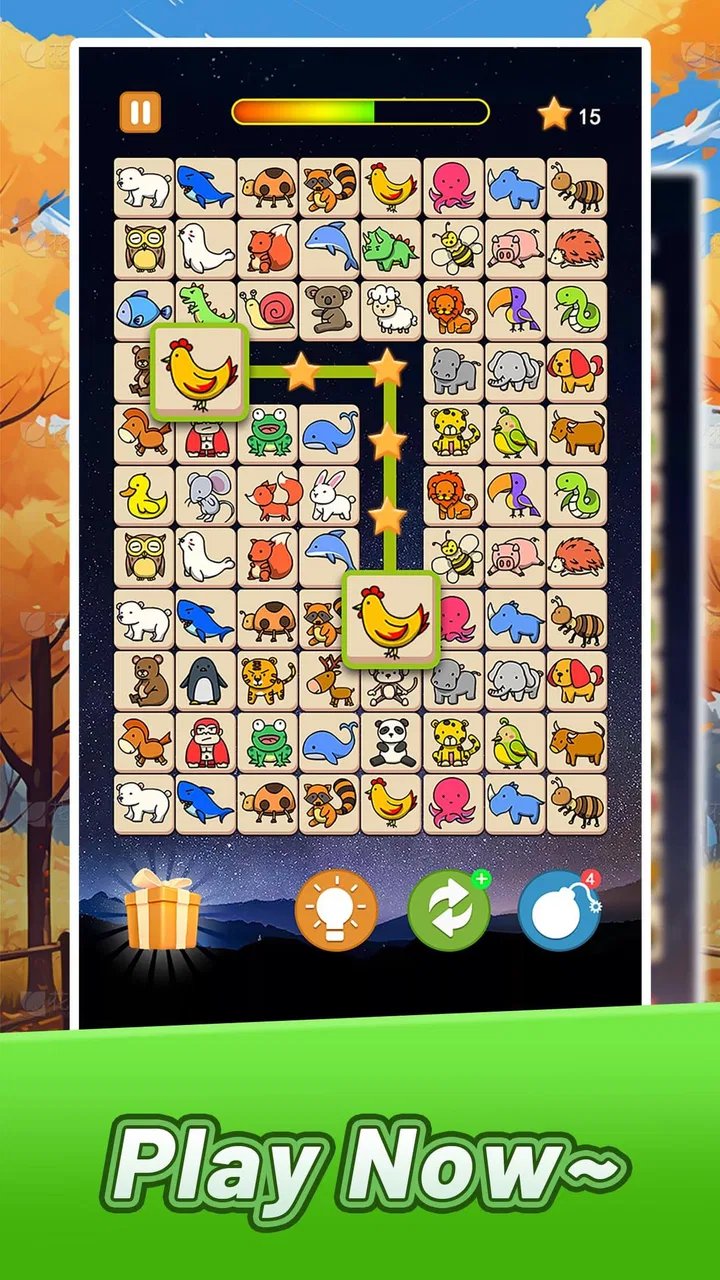
I approached Animal Match Link - Onet Tile as the kind of board game I could open for a few quiet minutes rather than a title demanding a long learning session. Its central idea is easy to understand: find matching animal tiles, connect them according to the game’s puzzle rules, and remove them from the board. That simplicity is the main attraction, but it also means the quality of each move matters more than flashy presentation.
Developed by BIGJOYSTUDIO, this free board game is aimed at a broad audience, with an Everyone content rating and support for devices running Android 6.0 or later. It has already passed the one-million-install mark and holds an average rating of 4.9 from around 7,400 ratings, so there is clearly strong interest in this particular take on tile matching. I found it most appealing when I wanted a calm, focused activity that still gave me a small problem to solve.
What to expect when you open Animal Match Link - Onet Tile
The first thing to understand is that this is not a traditional matching game where any two identical pictures can automatically be paired. The board asks me to look for a valid connection between two equal animal tiles. In practice, that turns every choice into a small visual-planning exercise: I am not only asking which pictures match, but also whether the board leaves enough room for the connection to work.
You May Also Like

 Blood Strike: 2.5 Anniversary
Blood Strike’s Loadouts Turn Every Drop Into a Tactical Gamble
A close look at Blood Strike’s custom loadouts: how fast access to signature weapons reshapes its battle royale rhythm, rewards preparation, and narrows the gap between fights.

 Pandora - Music & Podcasts
Pandora’s Music Is Easy to Start, but Harder to Recover
Pandora’s strength is its low-effort path from a seed to a station. Its weak spot is how much confidence it asks you to place in connection, setup, and quiet recovery.

 8 Ball Pool
 Is Built on Rivalries, Rematches, and Routine
A close look at the rivalries, rematches, shared routines, and unanswered safety questions that turn a quick pool match into a persistent mobile community.

 Samsung Music
’s Quiet Strength Is Playing What You Already Own
Its reach comes less from spectacle than from dependable access to a personal library. That simplicity is both the app’s strongest retention engine and its ceiling.

 AccuWeather: Weather Radar
AccuWeather Review: A Quick, Clear Forecast for Everyday Decisions
For everyday plans, the best forecast is the one you can understand quickly. AccuWeather makes rain timing, radar, and local conditions easy to act on, with a few trade-offs.

 Hill Climb Racing
Why Hill Climb Racing Still Turns Crashes Into One More Run
A tiny car, a bumpy hill and one more upgrade: Hill Climb Racing keeps resurfacing because its simple chaos makes every near-miss feel personal.
More From Our News Desk



That distinction gives the game more thought than its cheerful animal artwork might suggest. A pair can look obvious and still be unavailable because other tiles block the route. Conversely, a less noticeable pair may be the best move because removing it opens a useful lane for several later matches. The most satisfying moments come from spotting that second possibility before the board becomes crowded with awkward leftovers.
I would describe the pace as relaxed rather than urgent. It suits someone who likes sorting, scanning and gradually clearing a layout. If you prefer rapid taps, dramatic effects or a large competitive system around every move, this may feel restrained. The appeal is in the board itself and in the steady improvement of your visual reading, not in a complicated collection of extra systems.
The animal theme also makes the board approachable for younger players and for anyone who finds abstract symbols tiring. Similar pictures are easier to recognize at a glance than tiny numbers or unfamiliar icons. Still, the friendly appearance should not be mistaken for a game with no challenge. As the layout becomes less convenient, patience and planning become more useful than simply tapping the first pair I notice.
Why the connection rule changes the way I play
With ordinary tile matching, I can often search for identical images and remove them immediately. Here, I have to read the empty space around them. I pay attention to the outside edge of the board, the gaps created by previous removals and the tiles that are likely to become accessible after one pair disappears.
My most useful habit was to avoid clearing a pair just because it was available. I first scanned for matches that were limiting my options, especially tiles sitting in narrow spaces or near the middle of a crowded arrangement. Removing those at the right time can make the following search much easier. This is a small adjustment, but it turns the game from picture recognition into a sequence of deliberate decisions.
The best early move is often the one that improves the board, not the one that is easiest to see. That advice is especially helpful for a first-time player who reaches a point where several identical animals are visible but only one pairing keeps the remaining layout flexible.
Getting started without overthinking the first board
Installation is straightforward for compatible Android devices, and the game is free to download. The current version is 1.0.m260407.0. Once it is open, I recommend resisting the urge to rush through the first layout. The opening board is a useful place to learn how the game decides whether a connection is allowed, because the visual result of a successful match makes the rule easier to understand than a long explanation would.
For the first few moves, I would use a simple routine. Scan the full board once, identify all obvious animal pairs, then check which pairs have the clearest route. After that, look again at the spaces around the selected tiles. This second glance prevents a common beginner mistake: choosing two matching pictures that seem close but are separated by an arrangement that makes the connection invalid.
I also found it helpful to keep my eyes moving in a consistent pattern, such as left to right and then top to bottom. Random searching makes the board feel more confusing because I repeatedly inspect the same areas while overlooking a pair at the edge. A fixed scan is less exciting, but it makes the first successful clear arrive sooner and gives me a better sense of the board’s structure.
The game’s age rating makes it suitable for general audiences, but that does not mean every player will find it equally comfortable. Younger users may enjoy the animals and simple objective, while older players may appreciate it as a short concentration exercise. Anyone with difficulty distinguishing similar artwork or reading a busy board should try a few layouts before deciding whether the visual design works for them.
How to make the first successful match
When I teach someone the game, I suggest starting with a pair positioned near an open boundary. Edge tiles are usually easier to understand because there is more visible space around them. Once I select two identical animals, I check whether the game accepts the route before searching for another pair. That first successful action teaches more than simply removing tiles: it shows how the board treats open space and blocked areas.
After a pair disappears, I do not immediately tap the next visible match. I pause for a brief board reset. New gaps can reveal a pairing that was previously hidden, and the most useful move may now be different from the one I noticed before. This pause is one of the simplest ways to improve, because it turns every removal into fresh information instead of following a preplanned sequence that no longer fits the layout.
For a realistic everyday use, imagine waiting for a bus or taking a short break between tasks. I can open the game, clear a few pairs and stop when I need to return to something else. It works well in that setting because the basic loop is immediately understandable. On the other hand, if I am already mentally tired, the repeated visual search can become less relaxing than expected, especially when the board contains several similar-looking animals.
Common points of confusion for new players
The biggest source of confusion is assuming that identical tiles are always ready to match. They are not. The connection requirement is the heart of the game, so a pair’s position matters as much as its picture. When a match fails, I do not interpret that as a mistake in the game; I recheck the surrounding tiles and look for a route that the open spaces actually support.
Another easy mistake is focusing only on the center. Players naturally look where the board appears busiest, but an edge pair can be more valuable because clearing it may expose a longer route later. I now include the outside rows in every scan rather than treating them as background. This has made my searches faster and reduced the feeling that the board suddenly becomes impossible.
It is also tempting to tap quickly when I see two matching animals. That approach works for the first few obvious moves, but it can leave the remaining tiles arranged in an inconvenient way. I get better results by asking three questions: is the route valid, will removing this pair open useful space, and am I preserving another difficult pair for later? I do not need to calculate the entire board; considering just the next one or two consequences is enough.
Some players may wonder whether the game is aimed at children because of its animal theme. In my experience, the theme makes the rules welcoming, but the actual challenge can suit adults too. It is a good fit for someone who likes light puzzle games without a story campaign. It is less suitable for a player looking for deep strategy, long-term character development or a large multiplayer component.
Small habits that make difficult layouts clearer
One useful technique is to choose a “release” pair: two matching tiles whose removal is likely to create a broad opening. I look for these before dealing with pairs trapped in narrow spaces. The goal is not always to remove the hardest-looking pair first. Sometimes opening the board gives me more information and makes the hard pair simple a few moves later.
A second technique is to remember locations rather than repeatedly searching for pictures. If I notice one animal in the upper area and its partner near a side edge, I keep that relationship in mind while checking the route. This reduces visual clutter and helps me avoid restarting my search after every tap. It is particularly useful when several animals have similar colors or shapes.
A third trade-off involves speed. Fast play feels satisfying when the board is open, but slower play is usually better when the layout is crowded. I use a quick rhythm for obvious edge matches and a deliberate rhythm for central or partially blocked tiles. That change of pace keeps the early game smooth without sacrificing planning when the board requires more attention.
How it compares with other tile and board puzzles
Compared with a basic pair-matching game, this one asks for more spatial awareness. A conventional memory-style title tests whether I can remember where two identical images are located. Animal Match Link - Onet Tile adds a route check, so recognition alone is not enough. I need to combine memory, visual scanning and a little forward planning.
Compared with a match-three game, the experience is quieter and less dependent on creating chains or reacting to a changing grid. There is no need to build a large combination before making progress. Each pair is a small decision, and the board changes in a more controlled way after a successful clear. I prefer this when I want a puzzle I can think through rather than one that rewards rapid pattern reactions.
It also differs from elaborate puzzle adventures that surround their boards with stories, upgrades and missions. Here, the matching task remains the center of attention. That focus is a strength for first-time users who want to understand the game immediately, but it may feel limited to players who need constant novelty outside the puzzle itself.
The free entry point makes it easy to try, although in-app purchases range from $1.99 to $99.99 per item. I would approach those purchases carefully and decide whether the basic game already provides the kind of session I want before spending anything. The free version is the sensible starting point for most people, particularly if they are only looking for an occasional board game rather than a long-term hobby.
Who should try it, and who should skip it
I would recommend it to casual puzzle players, families looking for a simple shared activity and adults who enjoy short visual challenges. It is also a reasonable choice for someone moving from very basic matching games toward puzzles that require a little more planning. The animal theme lowers the barrier to entry, while the connection rule gives the game enough structure to stay interesting beyond the first few boards.
I would skip it if my priority were competitive play, a strong narrative or a deep strategy system. I would also choose a different board game if I wanted a large variety of modes or a highly customizable experience. This title’s identity comes from repeating and refining one clear idea. That focus is refreshing when it matches my mood, but it can become repetitive if I need constant changes in objectives.
Players who dislike visual searching should consider that trade-off before installing. The game is simple to operate, but simplicity does not remove the need to inspect the whole layout. If I want a puzzle that can be played almost automatically while my attention is elsewhere, this is not the right choice. It rewards looking closely, and the more crowded the board feels, the more that attention matters.
My next-step advice after the first few sessions
Once the basic connection rule feels natural, I would stop measuring success by how quickly I remove the first pairs. A better goal is to finish each move with a clearer board and more options. Before tapping, identify the pair you expect to be most useful, then check whether clearing it exposes another route. This turns the game into a manageable planning exercise instead of a race against your own impatience.
I would also use short sessions to learn the board’s visual language. After a few rounds, I became quicker at separating “same animal” from “usable match.” That distinction is the real skill the game develops. If a layout stalls, I take a complete scan from the edges inward rather than repeatedly tapping the same blocked pair. A reset in attention is often more useful than forcing a move.
For families, I think the best way to introduce it is to let a new player explain why a pair is valid before tapping it. That encourages observation without turning the game into a lesson. For solo players, I would keep the same habit privately: say, even silently, what makes the route work. It helps reveal whether I am making a considered choice or simply reacting to a familiar picture.
BIGJOYSTUDIO’s game is therefore at its best as a focused, approachable tile puzzle with a clear learning curve. Its free price and broad age rating make trying it easy, while the strong average rating and more than one million installs suggest that its straightforward format has found an audience. I enjoyed it most in short breaks, when I wanted something more engaging than idle tapping but less demanding than a full strategy game.
My final recommendation is positive, with one important condition: install it because you enjoy visual planning, not because the animal theme alone catches your eye. Give the first board time, learn to inspect routes rather than matching pictures blindly, and use open space as part of your strategy. Animal Match Link - Onet Tile is a good companion for calm puzzle sessions, provided you are comfortable with a focused format that values careful observation over constant variety.
FAQs for Animal Match Link - Onet Tile
01What is Animal Match Link - Onet Tile and how does it work?
Animal Match Link - Onet Tile is a puzzle game that challenges players to connect matching animal tiles within a set time limit. The game is designed with vibrant graphics and an intuitive interface, allowing players to simply tap tiles to match them. It's a test of speed and strategy, perfect for puzzle enthusiasts.
02Is Animal Match Link - Onet Tile free to play?
Yes, Animal Match Link - Onet Tile is free to download and play. However, it may contain in-app purchases that offer additional features or enhancements. These purchases are optional and not necessary for progressing through the game, allowing for a complete experience without spending money.
03What devices are compatible with Animal Match Link - Onet Tile?
Animal Match Link - Onet Tile is available for both Android and iOS devices. It requires Android version 5.0 or later and iOS version 10.0 or later. The game is optimized for smartphones and tablets, ensuring a smooth gaming experience on most modern devices.
04Are there any ads in Animal Match Link - Onet Tile?
Yes, Animal Match Link - Onet Tile includes ads, which help support the free version of the game. Ads may appear between levels or at the bottom of the screen. Users can choose to remove ads through an in-app purchase if they prefer an uninterrupted gaming experience.
05How can I improve my skills in Animal Match Link - Onet Tile?
Improving your skills in Animal Match Link - Onet Tile involves practice and strategic thinking. Focus on identifying quick matches and plan your moves to avoid getting stuck. Utilize power-ups wisely to clear difficult levels. Regular play will naturally enhance your speed and pattern recognition.
Pros
- Colorful and engaging graphics.
- Simple gameplay suitable for all ages.
- Offers offline play mode.
- Regular updates with new levels.
- Intuitive user interface.
Cons
- Ads can be frequent and intrusive.
- Limited power-ups available.
- No multiplayer mode.
- Requires in-app purchases for advanced features.
- Soundtrack can become repetitive.

Animal Match Link - Onet Tile
Gallery